UW-Eau Claire sophomore Tim Jacobs described the play – he crossed the field in the back of the end zone, trying to get in position for a pass. Once the throw was in the air, he realized it was too far behind him. As he dove backwards for the catch, he said the defender knocked his hand away, causing the pass to go incomplete.
Jacobs fell to the ground with his fingers extended and his body on top of his hand, putting his entire weight onto his thumb.
“Just heard a nice little crack,” Jacobs said.
Not knowing his thumb was broken, he attempted to play through the pain.
“I used a branch and band aids to wrap it…it made it hard to throw,” Jacobs said with a laugh.
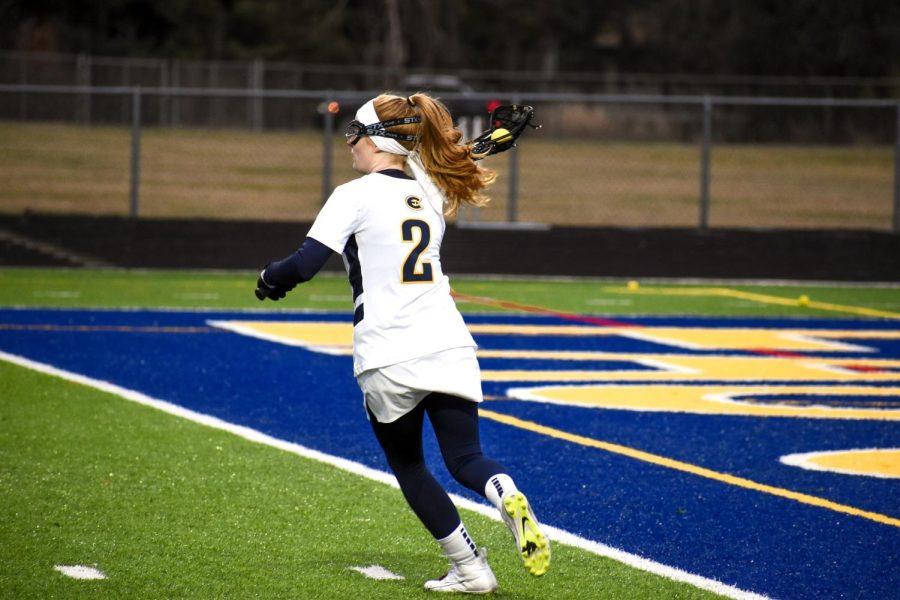
Though this type of toughness is normally found on the gridiron on Sundays, Jacobs was not playing football. His injury came during a recent Ultimate Frisbee meet. The men’s and women’s teams’ successes in recent years, along with the unique camaraderie they feel for each other and their sport, has helped the UW-Eau Claire Ultimate Frisbee club become presence on the national stage.
The rules are fair
When people watch Ultimate Frisbee – or “ultimate” for short – for the first time, they are usually impressed by the speed of the game, sophomore Ashley Steiner said.
“People are surprised by how much we move around,” she said.
The object of the game calls for high velocity, Jacobs explained. Similar to football, players on opposing teams try to move down the field and cross the end zone of the opposition, he said.
The non-contact sport is played on a field 70 yards long and 40 yards wide, with both end zones at a length of 25 yards, according to the Ultimate Players Association. Each score counts for one point and the first team to 15 points with a two-point lead wins, Jacobs said.
There are two different roles players can have on the field: cutter and handler. A cutter is like a wide receiver in football, Jacobs said, and his or her job is running downfield to catch passes. Handlers are more like quarterbacks with their main job being to get the disc to the cutters. Teams normally have four handlers and three cutters, Jacobs said, although various set-ups can come with different types of offense.
Once the disc is caught, players must stay in the spot the catch was made, only being allowed to pivot on one foot, similar to basketball. They have 10 seconds, which the defender counts off, to get rid of the disc before possession is relinquished, Jacobs said. Possession also changes if the disc hits the ground or the opposing team intercepts it.
What is unique about Ultimate Frisbee, Jacobs said, is the fact that there are no officials during games. There is an honor system among ultimate frisbee players, he said.
“It’s called ‘Spirit of the Game’ where you call your own fouls,” he said.
Senior Jaime Glader, one of the captains of the women’s team, said the “Spirit of the Game” is what sets ultimate frisbee apart from other sports.
“Ultimate is governed by ‘Spirit of the Game,'” Glader said. “Everything is self-officiated, so honor and respect are very important.”
Discography
Women’s team captain and senior Nicole Heiman, who has been on the team for five years, said she has seen the group go from being a co-ed team to the larger, multiple-squad outfit that it is today.
The men’s team began in spring 2001 under the name Kamikaze Snow Leopards, she said, which later changed to EauZone.
EauZone operated as a co-ed team that Heiman said she played on for two years. In 2005, she said she began working on creating a separate women’s team. In spring 2006, the women’s team, under the name SOL, competed in sectionals.
Glader, who helped Heiman create the women’s team, said the team has found plenty of success in its short time in existence. Last year, Glader said the women’s team placed fourth at regionals, one spot away from qualifying for nationals. She said she hopes that success will continue on through this year.
“We have a lot of work ahead, but the outlook is very good if we keep on improving,” she said.
The women’s team has won two tournaments so far this year, and finished in second and third with split teams at their home tournament, she said.
Glader said the Ultimate Frisbee team has traveled to Missouri, Iowa, Georgia and all around Wisconsin for tournaments, always driving themselves to each meet.
The men’s team is looking forward to a successful season in the spring, team captain junior Tim McNeal said. The team looks to improve on last year when Marquette bounced them out of the tournament.
“I’m very excited to see where this team goes,” McNeal said. “We have a lot of potential to make a strong showing this coming spring in the UPA series.”
Be aggressive
Despite the sport being “non-contact,” injuries are not uncommon for ultimate frisbee competitors. A visit to one of their practices shows several players wearing knee wraps or braces while doing drills. Bumps, bruises and tears are not unusual injuries for players.
Senior Tyler Jongewaard said he was sitting out during Monday’s practice with an injured knee.
Jongewaard said the injury came during a recent meet when he dove for a pass. He came down hard on the ground, directly on his knee, he said.
“Of course it was my bad knee,” Jongewaard said with a laugh, adding that sitting out of practice was a precaution just so he could give himself time to heal.
But even with the injury, Jongewaard helped the women’s team’s practice, retrieving discs and assisting in drills. He, along with the captains from both the men’s and women’s teams, led and taught in drills for the players.
Senior J.P. Severson said the dedication members of both squads have is impressive.
“A lot of guys show up to the 6 a.m. practice (every week),” Severson said. “(People) take it pretty damn serious.”
We’re in this together
Along with the players’ devotion to the sport, there is also a distinct devotion to the team as a whole.
When pressed for their most memorable experiences on the team, players commonly cited team successes instead of personal achievements.
Examples include a come-from-behind victory in the state tournament last year. It was the first time Severson said he thought his team truly played as a unit.
“The first time the team really clicked,” he said. “Every throw, every catch was flowing.”
Glader said the bond she has formed with teammates and opponents over the years has been her favorite part of being on the team.
“The variety of people you meet is amazing, all connected by the love of playing a game,” she said.
This could come from the nature of the sport, as people have more of a connection with the game because of the absence of officials on the field, several players said. Steiner said she was impressed with the energy of ultimate frisbee compared to other sports.
“There’s such a positive energy in this game,” she said. “In other sports you feel so negative towards the other team… it’s not like that (in ultimate frisbee).”
Glader summed up the team’s unity with her choice for the most memorable experience on the ultimate frisbee team.
“Everything,” she said. “There’s no way to choose only one thing. I love my team – they are my best and closest friends.”